

When shopping, new parents often describe their needs using phrases like "How many months old is the baby now?", "Where do you want to take the baby?", or "What are you most worried about?", instead of entering precise product names. This case study outlines how a friend's creative approach assisted the well-known Japanese baby and maternity product brand, Akachan Honpo, in using AI semantic search to handle cross-language, everyday questions that included multiple conditions.
I. Why is searching particularly difficult for new parents?
The selection of maternity and baby products involves considerations such as the baby's age, the occasion for use, the material, the climate, and care. Traditional keyword searches usually require customers to know the category or product name first, but new parents often want to ask about complete life issues.
- Contextual Questions:For example, "How should I choose clothes for a 6-month-old baby?" or "What sunscreen products are suitable for babies when going to Okinawa?"
- Cross-Language Differences:Overseas customers may know they need "baby diaper rash cream," but don't know which Japanese term to use to search.
- Explanation Needed, Not Just a List:Parents not only want to see products, but also want to know the recommendations, usage scenarios, and limitations to be aware of.
II. How does AI search break down context and cross-language matching?
1. Understand the needs first, then find the products
Taking "sunscreen suitable for babies to use when going to Okinawa" as an example, the system does not only compare the two words "sunscreen," but breaks down the query into conditions that affect the selection:
The AI then searches for matching options based on the store's existing Japanese product information, categories, and attributes. When it comes to infant and toddler products, the recommended content should still be based on the product labeling and information provided by the brand to avoid misinterpreting search suggestions as medical or care judgments.
Taking this question as an example, search results cannot assume all outdoor products are suitable for infants and young children simply because of "Okinawa," nor can they treat common sense about models as product facts. The system must return to the age ratings, usage instructions, ingredients, water resistance, and precautions provided by the merchant, presenting verifiable information separately from general purchasing directions; if the data is insufficient, customers should be clearly reminded to check the labels or consult professionals.
2. Allow customers to search using familiar languages
Customers can express their needs in Chinese. After understanding the meaning in the backend, the system will match the product content in Japanese. This is not a word-for-word translation of search terms, but rather preserving the target audience, context, and limitations as much as possible before matching products, reducing the chances that overseas customers will not find products due to different vocabulary.
3. Explain the selection direction first, then provide products
In addition to the product list, the search results will also first organize the purchasing direction and recommendation basis in the form of an "AI store manager," letting customers know how the system understands the problem. The following screens demonstrate how AI responses, recommended categories, and product results are presented in the Japanese interface.
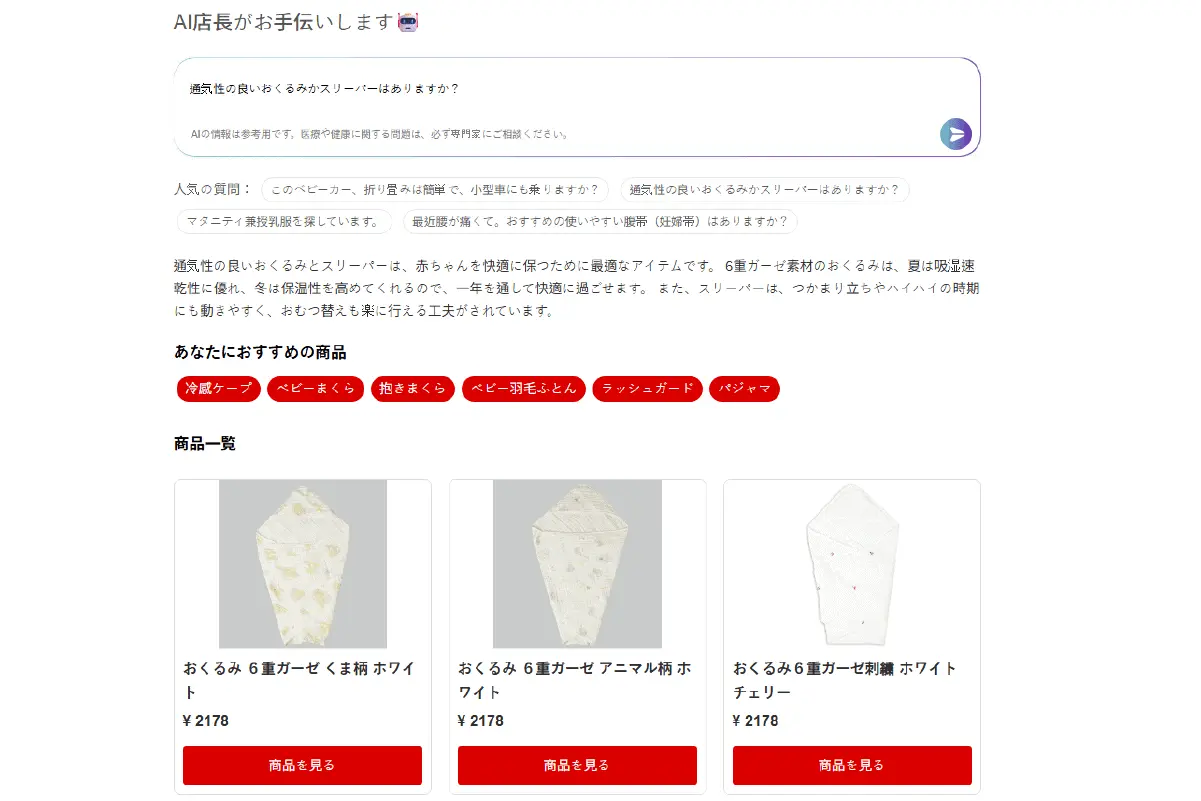
III. How to extend from the website to physical tours?
The same search and product understanding capabilities can also be extended to AI navigation devices in physical stores. Chinese-speaking travelers can directly ask questions in their familiar language, and the system will then provide directions based on product information, allowing online search and on-site service to share a more consistent knowledge base.
For brands, sharing knowledge online and offline not only benefits customers but also reduces the cost of maintaining responses for different service interfaces. Product updates, discontinuations, notices, or category adjustments can only provide consistent information if synchronized from the same reliable source. For parenting issues requiring individual judgment, an exit point for human assistance should also be maintained.
Case Study: Akachan Honpo AI Guided Tour Robot - Tokyo, Japan / Cobinyiu Creativity Watch on YouTube if playback fails ↗
IV. How should the value of this type of project be measured?
Without publicly available before-and-after comparison data, it is unreliable to directly claim an increase in conversion rate or revenue. A more reliable approach is to establish a baseline before implementation and then continuously track search and customer behavior.
The most important significance of this case is that it transforms product search from "customers must understand the product first" to "the system understands the customer's situation first." For brands with complex products, requiring trust, or serving international customers, this is where AI search is more worthy of validation than traditional keyword search.